Autobiography of Benjamin Franklin
Benjamin Franklin
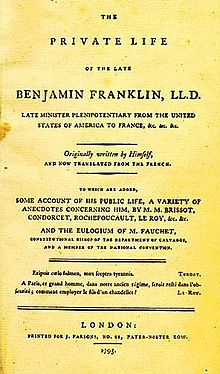
Description
The unfinished record of his own life written by Benjamin Franklin from 1771 to 1790.
| Length | Emails required |
|---|---|
| 1,030 lines | 26 (based on one per day) |
Preview - part 21 of 26
So much for Industry, my Friends, and Attention to one's own Business; but to these we must add _Frugality_.
_What maintains one Vice, would bring up two Children_. You may think perhaps, that a _little_ Tea, or a _little_ Punch now and then, Diet a _little_ more costly, Clothes a _little_ finer, and a _little_ Entertainment now and then, can be no _great_ Matter; but remember what _Poor Richard_ says, _Many a Little makes a Mickle._
_Beware of little expenses; A small Leak will sink a great Ship_; and again, _Who Dainties love, shall Beggars prove_; and moreover, _Fools make Feasts, and wise Men eat them._
Buy what thou hast no Need of, and ere long thou shalt sell thy Necessaries.
If you would know the Value of Money, go and try to borrow some; for, he that goes a borrowing goes a sorrowing.
The second Vice is Lying, the first is running in Debt.
_Lying rides upon Debt's Back_.
Poverty often deprives a Man of all Spirit and Virtue: '_Tis hard for an empty Bag to stand upright_.
And now to conclude, _Experience keeps a dear School, but Fools will learn in no other, and scarce in that_; for it is true, _we may give Advice, but we cannot give Conduct_, as _Poor Richard_ says: However, remember this, _They that won't be counseled, can't be helped_, as _Poor Richard_ says: and farther, That _if you will not hear Reason, she'll surely rap your Knuckles_.
THE WHISTLE
To Madame Brillon
Passy, November 10, 1779.
I am charmed with your description of Paradise, and with your plan of living there; and I approve much of your conclusion, that, in the meantime, we should draw all the good we can from this world. In my opinion, we might all draw more good from it than we do, and suffer less evil, if we would take care not to give too much for whistles. For to me it seems, that most of the unhappy people we meet with, are become so by neglect of that caution.
You ask what I mean? You love stories, and will excuse my telling one of myself.
When I was a child of seven year old, my friends, on a holiday, filled my pocket with coppers. I went directly to a shop where they sold toys for children; and being charmed with the sound of a _whistle_, that I met by the way in the hands of another boy, I voluntarily offered and gave all my money for one. I then came home, and went whistling all over the house, much pleased with my _whistle_, but disturbing all the family. My brothers, and sisters, and cousins, understanding the bargain I had made, told me I had given four times as much for it as it was worth; put me in mind what good things I might have bought with the rest of the money; and laughed at me so much for my folly, that I cried with vexation; and the reflection gave me more chagrin than the _whistle_ gave me pleasure.
This, however, was afterwards of use to me, the impression continuing on my mind; so that often, when I was tempted to buy some unnecessary thing, I said to myself, _Don't give too much for the whistle_; and I saved my money.
As I grew up, came into the world, and observed the actions of men, I thought I met with many, very many, who _gave too much for the whistle_.
When I saw one too ambitious of court favor, sacrificing his time in attendance on levees, his repose, his liberty, his virtue, and perhaps his friends, to attain it, I have said to myself, _This man gives too much for his whistle_.
When I saw another fond of popularity, constantly employing himself in political bustles, neglecting his own affairs, and ruining them by neglect, _He pays, indeed_, said I, _too much for his whistle_.
If I knew a miser who gave up every kind of comfortable living, all the pleasure of doing good to others, all the esteem of his fellow citizens, and the joys of benevolent friendship, for the sake of accumulating wealth, _Poor man_, said I, _you pay too much for your whistle_.
When I met with a man of pleasure, sacrificing every laudable improvement of the mind, or of his fortune, to mere corporeal sensations, and ruining his health in their pursuit, _Mistaken man_, said I, _you are providing pain for yourself, instead of pleasure; you give too much for your whistle_.
If I see one fond of appearance, or fine clothes, fine houses, fine furniture, fine equipages, all above his fortune, for which he contracts debts, and ends his career in a prison, _Alas_! say I, _he has paid dear, very dear, for his whistle_.
When I see a beautiful, sweet-tempered girl married to an ill-natured brute of a husband, _What a pity_, say I, _that she should pay so much for a whistle_!
In short, I conceive that great part of the miseries of mankind are brought upon them by the false estimates they have made of the value of things, and by their _giving too much for their whistles_.
Yet I ought to have charity for these unhappy people, when I consider, that, with all this wisdom of which I am boasting, there are certain things in the world so tempting, for example, the apples of King John, which happily are not to be bought; for if they were put to sale by auction, I might very easily be led to ruin myself in the purchase, and find that I had once more given too much for the _whistle_.
Adieu, my dear friend, and believe me ever yours very sincerely and with unalterable affection,
B. Franklin.
A LETTER TO SAMUEL MATHER
Passy, May 12, 1784.
Revd Sir,
It is now more than 60 years since I left Boston, but I remember well both your father and grandfather, having heard them both in the pulpit, and seen them in their houses. The last time I saw your father was in the beginning of 1724, when I visited him after my first trip to Pennsylvania. He received me in his library, and on my taking leave showed me a shorter way out of the house through a narrow passage, which was crossed by a beam overhead. We were still talking as I withdrew, he accompanying me behind, and I turning partly towards him, when he said hastily, "_Stoop, stoop!_" I did not understand him, till I felt my head hit against the beam. He was a man that never missed any occasion of giving instruction, and upon this he said to me, "_You are young, and have the world before you; stoop as you go through it, and you will miss many hard thumps_." This advice, thus beat into my head, has frequently been of use to me; and I often think of it, when I see pride mortified, and misfortunes brought upon people by their carrying their heads too high.
B. Franklin.
THE END
BIBLIOGRAPHY
The last and most complete edition of Franklin's works is that by the late Professor Albert H. Smyth, published in ten volumes by the Macmillan Company, New York, under the title, _The Writings of Benjamin Franklin_. The other standard edition is the _Works of Benjamin Franklin_ by John Bigelow (New York, 1887). Mr. Bigelow's first edition of the _Autobiography_ in one volume was published by the J. B. Lippincott Company of Philadelphia in 1868. The life of Franklin as a writer is well treated by J. B. McMaster in a volume of _The American Men of Letters Series_; his life as a statesman and diplomat, by J. T. Morse, _American Statesmen Series_, one volume; Houghton, Mifflin Company publish both books. A more exhaustive account of the life and times of Franklin may be found in James Parton's _Life and Times of Benjamin Franklin_ (2 vols., New York, 1864). Paul Leicester Ford's _The Many-Sided Franklin_ is a most chatty and readable book, replete with anecdotes and excellently and fully illustrated. An excellent criticism by Woodrow Wilson introduces an edition of the _Autobiography_ in _The Century Classics_ (Century Co., New York, 1901). Interesting magazine articles are those of E. E. Hale, _Christian Examiner_, lxxi, 447; W. P. Trent, _McClure's Magazine_, viii, 273; John Hay, _The Century Magazine_, lxxi, 447.
See also the histories of American literature by C. F. Richardson, Moses Coit Tyler, Brander Matthews, John Nichol, and Barrett Wendell, as well as the various encyclopedias. An excellent bibliography of Franklin is that of Paul Leicester Ford, entitled _A List of Books Written by, or Relating to Benjamin Franklin_ (New York, 1889).